

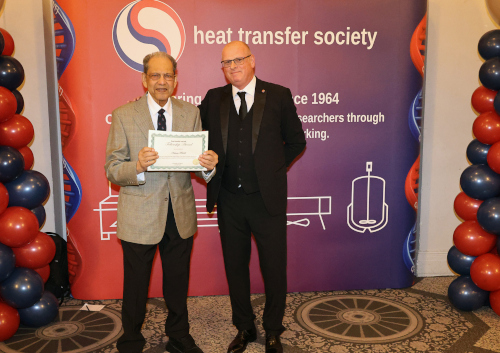
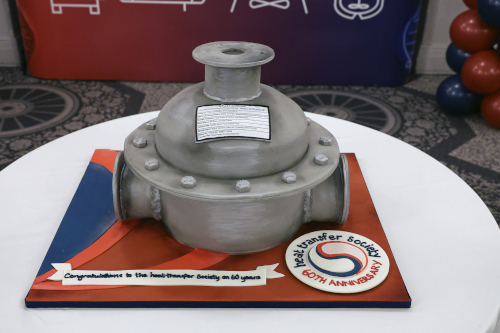
 We are pleased to announce that our 60th Annual Dinner raised £1,049 for this year's nominated charity, Diabetes UK. The addition of Gift Aid boosted the final donation to £1,311.25. A huge thank you to everyone who contributed to this fantastic total!
Dr. Hezlin Ashraf of E. J. Bowman (Birmingham) Ltd.,
Martin Gough of CALGAVIN Ltd,
Chris Hart of Graham Hart (Process Technology) Ltd,
Malcolm Robbins of Dove Thermal,
Simon Parsons of Abbey Industrial Sales Co. Ltd
and, of course, our Chairman and master of ceremonies for the evening, David Norton of Boustead International Heaters.
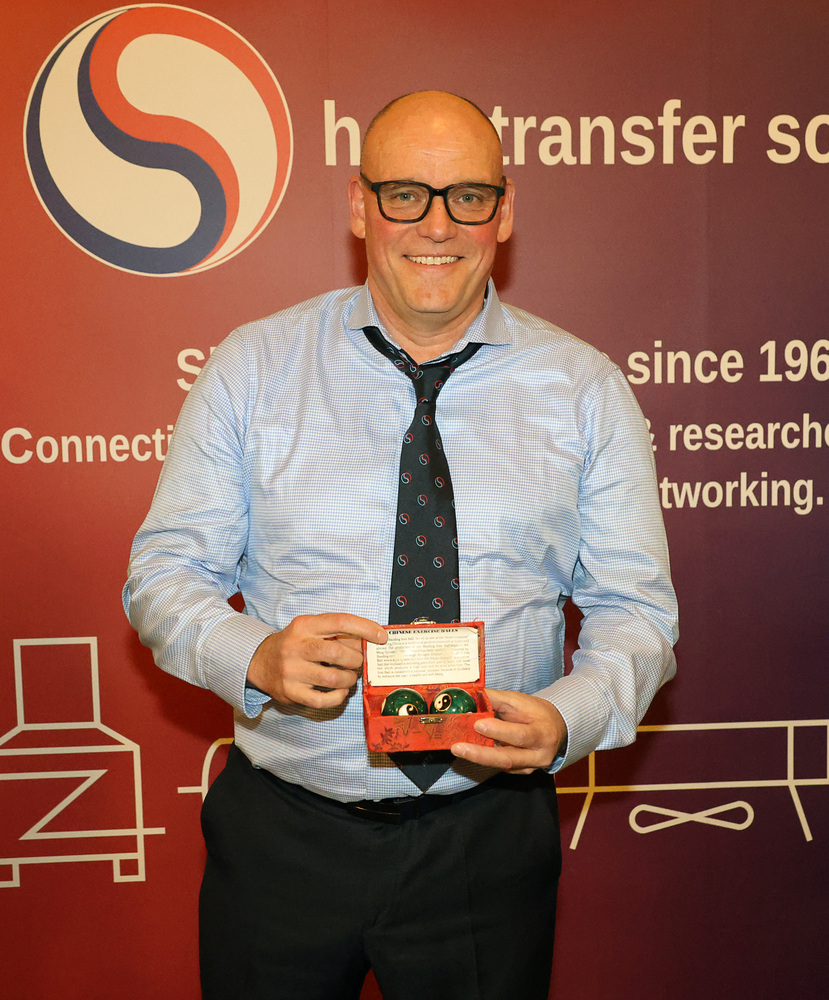
Mr. Chairman, Fellow members of the heat transfer society, dear guests, colleagues, and friends, Ladies and Gentlemen. I have promised Agnes, that I will keep this brief, and those of you who know Agnes I better do as she says. It is both a great honor and a deeply humbling moment for me to stand before you tonight as the newly elected President of the UK Heat Transfer Society, as we celebrate its 60th anniversary.
Sixty years.
That is not just a number—it is a legacy. A legacy of curiosity, of engineering excellence, and of a community that has quietly, persistently, and profoundly shaped the heat transfer world. Allow me to begin on a personal note.
My own journey into heat transfer was, like many in this room, not a straight line. It started with general interest in thermodynamics, fluid flow and gas dynamics during my studies at the University of Karlsruhe. Followed by my move to the UK, to work with Hans Mueller-Steinhagen on my PhD, linking thermodynamics, heat transfer and real-world applications—the point where equations meet surfaces, heat exchangers and ultimately, industry. My research career has focused largely on fouling—an unglamorous word, perhaps, but one that represents one of the most persistent and costly challenges in thermal systems.
Fouling, as you all know, is the unwanted accumulation of materials on heat transfer surfaces—whether biological, chemical, or particulate. It reduces efficiency, increases energy consumption, drives up operational costs, and, in some cases, leads to catastrophic failure. In other words, fouling is the silent enemy of heat transfer. Over the years, my work has explored both the mechanisms of fouling and, more importantly, ways to mitigate it. Working on the development and application of advanced surface coatings—engineered interfaces designed to resist adhesion, reduce deposition, and maintain thermal performance over time. These coatings, often inspired by nature and enabled by advances in materials science, aim to create surfaces that are not just passive, but active participants in maintaining system efficiency. What fascinated me—and continues to fascinate me—is that sometimes the biggest gains in performance do not come from redesigning entire systems, but from rethinking the smallest interface: the surface.
That brings me to the broader field we all share. Heat transfer is, in many ways, the invisible backbone of modern civilization. It is present in every power plant, every chemical reactor, every refrigeration cycle, every data center, every vehicle, and indeed, every home. From the earliest understanding of conduction, convection, and radiation, to today’s highly complex multiphase and microscale systems, heat transfer has enabled progress across industries. In process engineering, heat transfer is not just important—it is fundamental. It governs reaction rates. It determines energy efficiency. It influences product quality. It defines operational limits. A well-designed heat exchanger can reduce energy consumption dramatically. A poorly performing one—perhaps due to fouling—can cost millions in lost efficiency and downtime.
And this is where our community, and the Heat Transfer Society plays such a critical role. We are not just solving academic problems. We are enabling industries. From petrochemicals to pharmaceuticals, from food processing to renewable energy, the principles of heat transfer underpin the systems that sustain modern life. And as we move toward a more sustainable future, our role becomes even more important. Energy efficiency is no longer optional—it is essential. Decarbonization efforts depend heavily on improved thermal management, waste heat recovery, and innovative heat transfer technologies. Some of these are represented here in the room.
The UK Heat Transfer Society was founded six decades ago with a clear purpose: to bring together academics, engineers, and industry professionals to advance the science and application of heat transfer.
Over these 60 years, the Society has:
• Fostered collaboration across disciplines
• Supported generations of researchers and practitioners
• Hosted and collaborated on conferences and workshops that have shaped thinking
• Provided a platform for sharing knowledge and innovation
It has been a place where ideas are tested, challenged, and refined. But perhaps more importantly, it has been a community. A community that values rigor, openness, and the exchange of ideas. A community that understands that progress is rarely achieved in isolation.
When the Society was founded, the tools available to engineers were very different from those we have today. Slide rules instead of supercomputers. The early stages of heat exchanger design software of research companies like HTFS and HTRI. Empirical correlations instead of high-fidelity simulations. Limited experimental diagnostics compared to today’s advanced imaging and measurement techniques.
And yet, the core principles remain unchanged. What has evolved is our ability to explore, model, and optimize.
Today, we are working on challenges that were unimaginable 60 years ago:
• Heat transfer at the nanoscale
• Thermal management of high-performance electronics
• Advanced coatings and surface engineering
• Heat transfer enhancements, and efficiency improvements, like inserts, special surfaces and new surface geometries
• Phase change materials for energy storage
• Heat transfer in renewable energy systems
• The digital transformation of entire processes
And yes—still, fouling. Because while technology advances, fundamental challenges persist.
Despite decades of research, fouling remains a major issue across industries. It is estimated to cost billions annually in lost efficiency and maintenance. But there is reason for optimism. Advances in surface engineering—particularly in coatings—are opening new pathways. Hydrophobic and superhydrophobic surfaces. Anti-adhesive and self-cleaning coatings. Smart materials that respond to environmental conditions. These innovations are not just incremental improvements—they have the potential to transform how we design and operate thermal systems. Heat transfer is not just about bulk properties—it is about interfaces. And sometimes, solving a macro problem requires a micro solution.
As we look to the future, our field faces both challenges and opportunities. Climate change demands more efficient energy systems. Electrification requires better thermal management. Digitalization opens new possibilities for monitoring and optimisation. And across all of this, heat transfer remains central.
As President of the UK Heat Transfer Society, and maybe even more so as the president of HTRI, my vision is to build on our strong foundation and focus on three key areas:
- Strengthening Collaboration
Bridging academia and industry more effectively, ensuring that research translates into real-world impact. - Supporting the Next Generation
Encouraging young engineers and researchers, providing them with opportunities, mentorship, and a strong professional network. - Driving Innovation
Promoting emerging areas such as advanced materials, digital twins, and sustainable thermal systems.
If there is one thing that defines our field, it is this: We work on what is often invisible. Heat cannot be seen. Efficiency gains are rarely celebrated publicly. A well-functioning heat exchanger does not make headlines.
And yet, without heat transfer, much of modern life would simply not function.
So tonight, as we celebrate 60 years of the UK Heat Transfer Society, let us also celebrate the quiet impact of our work. The systems that run more efficiently because of it. The energy that is saved. The emissions that are reduced. The industries that are enabled.
I would like to express my sincere gratitude to all those who have contributed to the Society over the past six decades. To the past presidents, the committee members, the researchers, the engineers, and the students—thank you
I am deeply honored to serve as your President, in the 60th year of the existence of the heat transfer society. Together, let us build on the past, embrace the present, and shape the future.
Raise your glasses to the subject that brought us all here tonight, heat transfer and its UK society

60th H. T. S. ANNUAL DINNER
Friday 27th March 2026
GRAND CONNAUGHT ROOMS, WC2 - 6.00 for 7.00 pm
